The Narrator Reunites with His Birth Parents
The Painted BirdThe Narrator Reunites with His Birth Parents is a turning point in which the unnamed boy narrator is identified and reclaimed by his family, yet reunion does not restore a simple sense of home. A birthmark confirms who he is; leaving the orphanage brings him into his parents’ care and into a changed family, but he remains attached to the independence and imagined future built during his years apart from them. The scene makes recognition a beginning rather than a resolution: he is found, but still does not know how to belong.
The search and the meeting
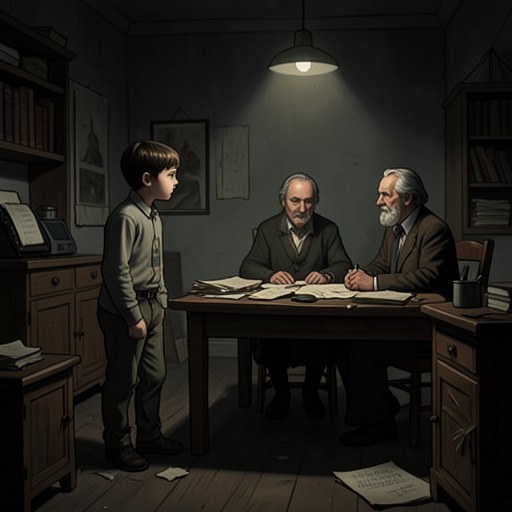
Early one morning, a teacher summons the boy to the principal’s office. He initially wonders whether the news concerns Red Army mentor Gavrila, then grows uncertain as he approaches. The principal is there with a member of the Social Commission, the official who believes he knew the boy’s parents before the war. Their cordial greeting cannot conceal their nervousness, and voices from an adjoining room signal that the meeting has been prepared in advance.
The commission member opens the door to a man and a woman. The boy finds their faces strikingly familiar and recognizes that they could be his parents, but he does not immediately acknowledge that possibility. Beneath the star on his uniform, he can feel his heart beating; he grips his chair and weighs whether to reveal recognition or feign indifference. The pause matters because the reunion is not simply a discovery made for him. He understands that accepting it will alter his life, and for a moment he still has a choice about how to answer.
The woman bends toward him in tears, while the man, visibly shaken, supports her and tries to compose himself. He speaks Russian fluently and asks the boy to unbutton his uniform so that they can look for a birthmark on the left side of his chest. The boy knows it is there. He hesitates, aware that showing it will remove any doubt, but the woman’s distress moves him to open his uniform. The birthmark confirms his identity; his parents embrace and kiss him, and the reunion becomes undeniable.
Recognition and reluctance
Confirmation does not make the boy’s feelings uncomplicated. He recalls that Red Army mentor Gavrila had told him parents had a right to their children, and he knows he is only twelve and not yet grown. To him, that principle turns the meeting into more than an emotional recognition: once the birthmark settles who he is, he believes his parents must take him away, whether or not they wish to. The obligation of family arrives at the same instant as its affection.
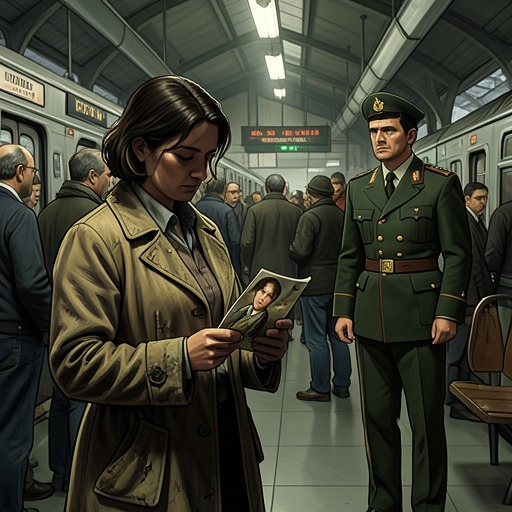
He studies the pair and judges them frail and unwell rather than threatening. Yet the tenderness of their response does not erase his hesitation. He knows he could run away, board one of the crowded trains, and disappear beyond their reach. He also wants Red Army mentor Gavrila to find him, so staying where he can be found seems wiser than escape. His decision is therefore divided: he allows the reunion to proceed, but his hoped-for future still belongs partly to the world he associates with Gavrila and Mitka the Cuckoo.
That imagined future has specific stakes. Rejoining his parents means giving up his dream of becoming an inventor of fuses that could change people’s color and of working in the land of Red Army mentor Gavrila and Mitka the Cuckoo, where, in his imagination, tomorrow has already arrived. The vision combines invention, a different political world, and a future he has chosen for himself. The parents’ return does not disprove that vision; it places it in conflict with a life organized around family, care, and obedience.
Leaving the orphanage
When the boy’s father returns, both parents embrace him, look him over, and exchange comments about him. The family prepares to leave the orphanage and goes to say goodbye to The Silent One. He watches the parents warily, shakes his head, and refuses to greet them. His refusal leaves the boy’s old connection present at the threshold of the new one: the reunion does not draw every person in the orphanage into the family’s circle, nor does it make the boy’s previous world disappear.
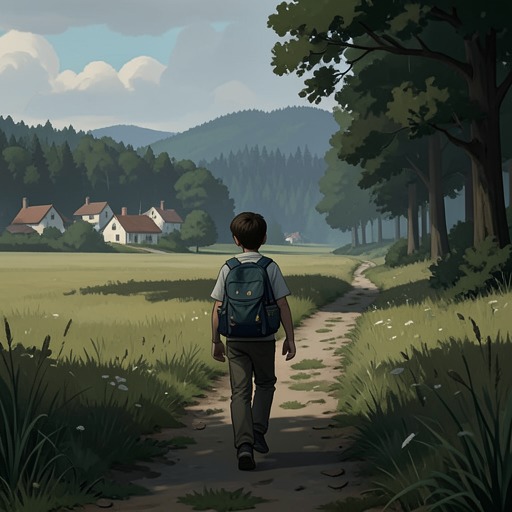
Outside, the father carries some of the boy’s books. Their departure takes place amid postwar disorder: ragged, exhausted people carrying sacks are returning home and disputing with those who occupied their homes during the war. The boy walks between his parents, aware of their hands on his shoulders and hair, but experiences their protection as smothering. The detail complicates the expected comfort of being recovered. Their touch communicates care, while its closeness makes the world around him feel newly constricted.
The parents take him to an apartment they have managed to borrow with difficulty after hearing that a boy matching their son’s description was at the local center. There he discovers that they have another child, a four-year-old orphan whose parents and older sister were killed. An old nurse saved the child and handed him to the father during the family’s wanderings in the third year of the war; the parents adopted him and clearly love him. The reunion thus reveals that the family has changed during the separation: the boy returns not to an unchanged household, but to one in which another bereaved child has already been made a son.
An unresolved return
The adopted child’s presence deepens the boy’s uncertainty rather than settling it. He wonders whether it would be better to remain alone and wait for Red Army mentor Gavrila, who might eventually adopt him. Wandering without knowing what would happen next seems preferable to a home where the future appears predictable. His response is not evidence that his parents reject him; he sees their affection. Instead, their care confronts him with a form of belonging that entails dependence and a changed identity as someone’s real son.
The event closes on this tension, not on a declaration of reconciliation. The boy has been identified, embraced, and taken from the orphanage, but he cannot readily accept that he must now be cared for and obey his parents because they are his parents. The reunion restores a factual family relationship while leaving its emotional meaning unsettled. Its decisive consequence is therefore double: the separation ends in practical terms, but the boy’s desire for freedom and chosen direction survives inside the newly reunited family.